
Thermostat Setbacks and Steady Heating: Which Habits Help an ASHP Work Smoothly?
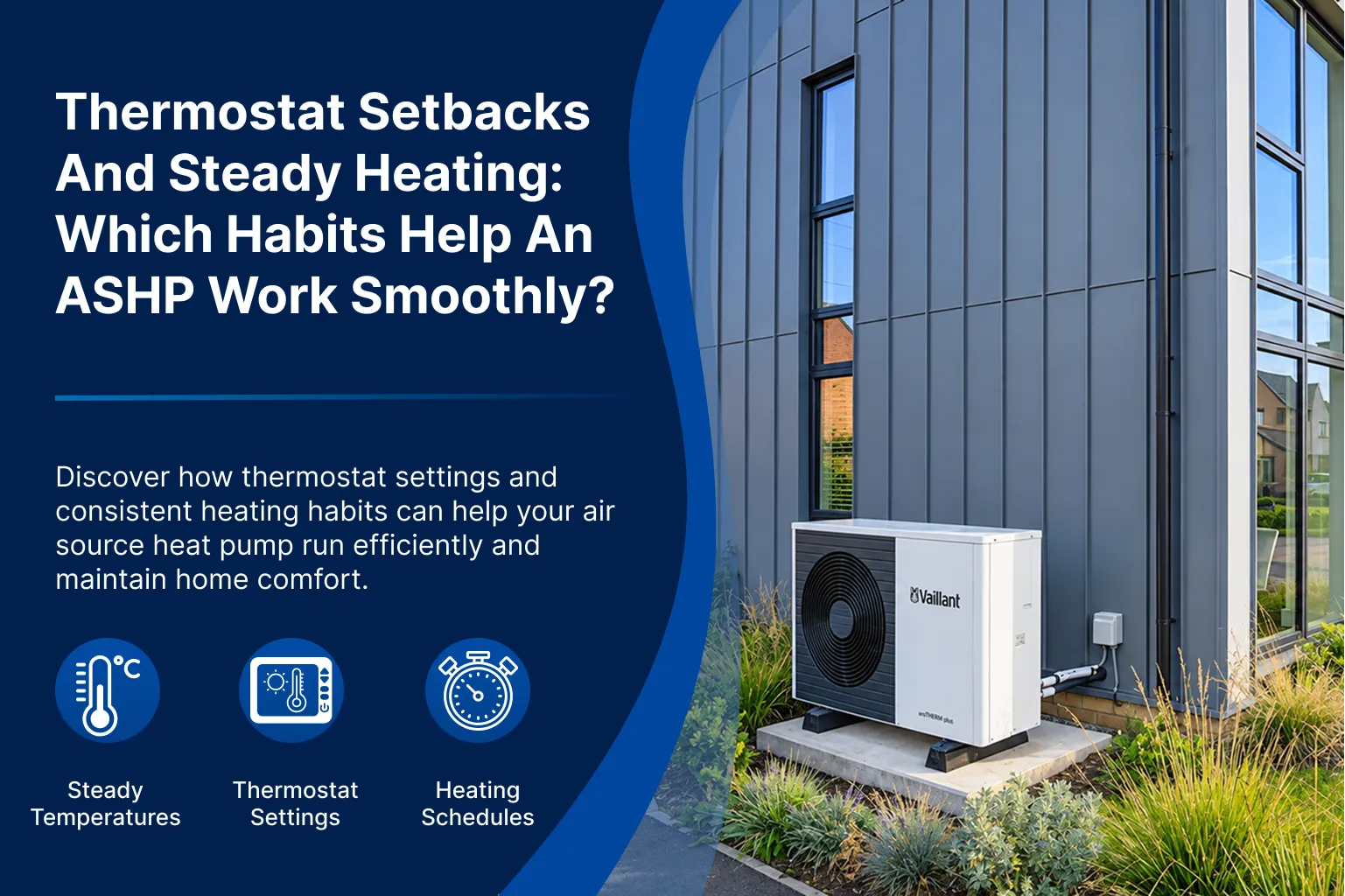
Discover how thermostat settings and consistent heating habits can help your air source heat pump run efficiently and maintain home comfort.

Why you can trust our content
Air source heat pumps can be complex, with lots of conflicting information around efficiency, installation and running costs. That’s why we rely on trusted expertise and proven industry standards to guide every installation.
At a glance
When temperatures drop outside, it can be tempting to turn the thermostat up sharply, leave the heating running at full power for a while, and turn everything off once the house feels warm. This approach may be familiar to homeowners who have used a conventional boiler for years, but an air source heat pump often benefits from a different routine.
Heat pumps generally work most effectively when they maintain a comfortable indoor temperature without frequent, substantial changes to the heating demand. That does not mean the heating must run at exactly the same setting every hour. Instead, the aim is to avoid unnecessary temperature swings while allowing the system to respond to the household’s routine.
For Newcastle homeowners, understanding thermostat setbacks, heating schedules and flow temperatures can make everyday operation easier. A few sensible habits may improve comfort, although the best settings always depend on the property, the equipment and the system design.
Why Do Heat Pumps Often Benefit From Steady Heating?
An air source heat pump transfers heat from outdoor air into the home. Unlike a conventional boiler that can deliver very hot water to radiators for rapid warm-up, a heat pump commonly supplies lower-temperature water over longer periods.
This operating pattern means that allowing the home to cool significantly before demanding a rapid rise in temperature may not be the most comfortable approach.
Steady heating can help because it:
- Reduces large swings between indoor temperatures.
- Gives the system time to maintain comfort gradually.
- Helps avoid unnecessary attempts to recover heat after a substantial setback.
- Supports consistent operation when the system is correctly designed.
- Makes it easier to identify genuine heating problems rather than normal temperature changes.
However, continuous operation is not automatically the most efficient choice for every household. The system should be controlled according to the manufacturer’s guidance, the building’s heat loss and the occupants’ needs.
If you are planning heat pump installation in Newcastle upon Tyne, ask how the proposed controls will work with your daily routine before deciding which thermostat schedule to use.
What Is a Thermostat Setback, and When Should You Use One?
A thermostat setback means reducing the target indoor temperature for a period rather than switching the heating off completely.
For example, a household might choose a slightly lower temperature overnight or while everyone is away during the day. The system then works towards the normal comfort temperature when needed.
The important question is how far the temperature should be reduced and for how long.
A small setback may be appropriate for a well-insulated home where indoor temperatures remain fairly stable. A larger reduction could mean the heat pump needs considerably longer to restore comfort, particularly in a property that loses heat quickly.
Consider these situations:
- Overnight: A modest reduction may suit some households, provided bedrooms remain comfortable.
- During working hours: A setback may be useful if the property is empty for much of the day.
- During short absences: Maintaining a fairly steady temperature may be more practical than making repeated changes.
- During longer holidays: Use the manufacturer’s recommended away or holiday settings, taking account of frost protection and other system requirements.
There is no universal setback temperature that suits every property. The correct approach depends on how quickly the building loses heat and how readily the heating system can restore the desired conditions.
Should You Turn the Heat Pump Off When You Leave Home?
For many households, turning the heating completely off for a short absence is unnecessary. However, whether it saves energy to reduce the temperature depends on the property, outdoor conditions and how long the home will be empty.
When the indoor temperature falls, the building loses heat more slowly because the difference between indoor and outdoor temperatures becomes smaller. Reheating the property later uses energy, but maintaining a higher temperature throughout the absence also requires energy.
The balance between these effects depends on the circumstances.
| Household situation | Possible control approach | What to consider |
| Home occupied throughout the day | Maintain a stable comfort setting | Prioritise consistent temperatures |
| Home empty for several hours | Try a modest setback | Avoid an unnecessarily large temperature drop |
| Overnight sleeping hours | Use a small reduction if comfortable | Consider bedroom temperatures and recovery time |
| Weekend away | Use an appropriate away setting | Follow guidance on frost protection and system operation |
| Extended winter holiday | Use the manufacturer’s holiday mode where available | Protect the property and follow any minimum-temperature requirements |
These are starting points rather than fixed rules. A well-insulated home may respond differently from an older, draughty property.
If you are uncertain how your controls should be configured, a heat pump installation specialist can explain which options suit your equipment and help you avoid unnecessary adjustments.
How Can Thermostat Placement Affect Comfort?
Your thermostat can only respond to the temperature it measures. If it sits in a warm hallway, near a sunny window or close to another heat source, its reading may not represent conditions in the rooms where your household spends most of its time.
This can create confusing results. The thermostat may register the target temperature and reduce the heating demand even though a colder bedroom or living area still feels uncomfortable.
To help the system respond appropriately:
- Keep the thermostat away from direct sunlight.
- Avoid placing it close to radiators, fireplaces or other heat sources.
- Check whether draughts affect the temperature reading.
- Review how the main thermostat works alongside thermostatic radiator valves or room sensors.
- Ask your installer to assess the control arrangement if some rooms consistently remain colder.
The aim is not simply to find a convenient place for the thermostat. Its location and relationship with other controls should reflect the heating system’s design.
What Is the Difference Between Room Temperature and Flow Temperature?
Room temperature is the warmth measured inside your home. Flow temperature is the temperature of the water leaving the heat pump and travelling towards the radiators or underfloor heating.
These settings serve different purposes.
The room thermostat helps determine when the home needs more or less heat. The flow temperature influences how much heat the emitters can transfer into the rooms.
Increasing the flow temperature may help a property warm up more quickly in some circumstances, but it can also reduce the heat pump’s efficiency. Keeping it unnecessarily high throughout mild weather may therefore waste energy.
Many systems use weather compensation, which adjusts the water temperature according to outdoor conditions. This allows the heat pump to provide less intense heating when the weather is milder and increase output when more heat is required.
Homeowners should avoid repeatedly changing flow-temperature settings without understanding their purpose. If the property cannot maintain a comfortable temperature during cold weather, the underlying cause may be radiator sizing, heat loss, circulation or system configuration rather than the thermostat itself.
If you are considering heat pump installation in Newcastle upon Tyne, contact Nicholson Heating Services LTD to discuss system controls and how they can be configured for your home.
Which Everyday Habits Help a Heat Pump Run Smoothly?
Good operating habits do not need to be complicated. In most cases, consistency and observation are more useful than making frequent adjustments.
Give the system time to respond
Heat pumps often take longer to change indoor temperatures than traditional boilers. After making a reasonable thermostat adjustment, allow sufficient time for the property to respond before making another change.
Keep a record of recurring problems
If a particular room feels cold every evening or the temperature drops overnight, note when it happens and what the controls are doing. This information can help an installer identify patterns.
Avoid unnecessary manual overrides
Repeatedly switching between different temperatures and operating modes can make it difficult to understand how the system performs under normal conditions.
Follow the manufacturer’s guidance
Use the recommended operating modes and avoid changing specialist settings without appropriate advice. This is particularly important where the controls manage hot water, frost protection or safety-related functions.
Check the basics before assuming there is a fault
Make sure the thermostat has not been changed accidentally, the heating schedule is active, and any visible error messages are recorded. Do not remove covers or attempt electrical repairs yourself.
These habits make it easier to distinguish between normal heat pump behaviour and an issue that needs professional attention.
When Should You Ask an Installer to Review Your Settings?
A heat pump should be able to provide appropriate comfort when its design, controls and emitters suit the property. If you repeatedly need to raise the thermostat to an uncomfortable level just to warm the home, it is worth investigating.
Professional advice is particularly useful when:
- Indoor temperatures remain below the target for extended periods.
- The system runs for long periods but cannot maintain comfort.
- One or more rooms remain consistently colder than others.
- Energy use appears unexpectedly high compared with previous periods.
- Heating performance changes after a service, repair or control adjustment.
- Error messages appear, or the system stops operating normally.
An MCS-certified air source heat pump installer can review the installation design, heat-loss calculations, emitter sizes and control settings where relevant. MCS certification relates to recognised standards for renewable heating installations, but the precise work required still depends on the equipment and the problem reported.
Avoid assuming that every issue can be solved by changing the thermostat. The correct diagnosis may involve the wider heating system.
If your heating routine never seems to deliver consistent comfort, speak to Nicholson Heating Services LTD about having the system and its controls assessed.
Find a Heating Routine That Suits Your Home
Steady heating, sensible thermostat setbacks and correctly configured controls can make an air source heat pump easier to live with. The goal is not to follow a rigid schedule, but to find an approach that keeps your home comfortable without unnecessary temperature changes.
Start with the manufacturer’s recommended settings, observe how your home responds and avoid making several adjustments at once. If comfort remains inconsistent, a professional assessment can help determine whether the issue relates to the controls, emitters or wider system design.
Nicholson Heating Services LTD can help homeowners understand their heating options and the practical considerations involved in running an air source heat pump. With the right advice, you can establish a heating routine that reflects your property and everyday needs.
Contact Nicholson Heating Services LTD to discuss your heating requirements and get tailored guidance on suitable heat pump controls.
Related articles

Which option best describes your home?
At a glance
When temperatures drop outside, it can be tempting to turn the thermostat up sharply, leave the heating running at full power for a while, and turn everything off once the house feels warm. This approach may be familiar to homeowners who have used a conventional boiler for years, but an air source heat pump often benefits from a different routine.
Heat pumps generally work most effectively when they maintain a comfortable indoor temperature without frequent, substantial changes to the heating demand. That does not mean the heating must run at exactly the same setting every hour. Instead, the aim is to avoid unnecessary temperature swings while allowing the system to respond to the household’s routine.
For Newcastle homeowners, understanding thermostat setbacks, heating schedules and flow temperatures can make everyday operation easier. A few sensible habits may improve comfort, although the best settings always depend on the property, the equipment and the system design.
Why Do Heat Pumps Often Benefit From Steady Heating?
An air source heat pump transfers heat from outdoor air into the home. Unlike a conventional boiler that can deliver very hot water to radiators for rapid warm-up, a heat pump commonly supplies lower-temperature water over longer periods.
This operating pattern means that allowing the home to cool significantly before demanding a rapid rise in temperature may not be the most comfortable approach.
Steady heating can help because it:
- Reduces large swings between indoor temperatures.
- Gives the system time to maintain comfort gradually.
- Helps avoid unnecessary attempts to recover heat after a substantial setback.
- Supports consistent operation when the system is correctly designed.
- Makes it easier to identify genuine heating problems rather than normal temperature changes.
However, continuous operation is not automatically the most efficient choice for every household. The system should be controlled according to the manufacturer’s guidance, the building’s heat loss and the occupants’ needs.
If you are planning heat pump installation in Newcastle upon Tyne, ask how the proposed controls will work with your daily routine before deciding which thermostat schedule to use.
What Is a Thermostat Setback, and When Should You Use One?
A thermostat setback means reducing the target indoor temperature for a period rather than switching the heating off completely.
For example, a household might choose a slightly lower temperature overnight or while everyone is away during the day. The system then works towards the normal comfort temperature when needed.
The important question is how far the temperature should be reduced and for how long.
A small setback may be appropriate for a well-insulated home where indoor temperatures remain fairly stable. A larger reduction could mean the heat pump needs considerably longer to restore comfort, particularly in a property that loses heat quickly.
Consider these situations:
- Overnight: A modest reduction may suit some households, provided bedrooms remain comfortable.
- During working hours: A setback may be useful if the property is empty for much of the day.
- During short absences: Maintaining a fairly steady temperature may be more practical than making repeated changes.
- During longer holidays: Use the manufacturer’s recommended away or holiday settings, taking account of frost protection and other system requirements.
There is no universal setback temperature that suits every property. The correct approach depends on how quickly the building loses heat and how readily the heating system can restore the desired conditions.
Should You Turn the Heat Pump Off When You Leave Home?
For many households, turning the heating completely off for a short absence is unnecessary. However, whether it saves energy to reduce the temperature depends on the property, outdoor conditions and how long the home will be empty.
When the indoor temperature falls, the building loses heat more slowly because the difference between indoor and outdoor temperatures becomes smaller. Reheating the property later uses energy, but maintaining a higher temperature throughout the absence also requires energy.
The balance between these effects depends on the circumstances.
| Household situation | Possible control approach | What to consider |
| Home occupied throughout the day | Maintain a stable comfort setting | Prioritise consistent temperatures |
| Home empty for several hours | Try a modest setback | Avoid an unnecessarily large temperature drop |
| Overnight sleeping hours | Use a small reduction if comfortable | Consider bedroom temperatures and recovery time |
| Weekend away | Use an appropriate away setting | Follow guidance on frost protection and system operation |
| Extended winter holiday | Use the manufacturer’s holiday mode where available | Protect the property and follow any minimum-temperature requirements |
These are starting points rather than fixed rules. A well-insulated home may respond differently from an older, draughty property.
If you are uncertain how your controls should be configured, a heat pump installation specialist can explain which options suit your equipment and help you avoid unnecessary adjustments.
How Can Thermostat Placement Affect Comfort?
Your thermostat can only respond to the temperature it measures. If it sits in a warm hallway, near a sunny window or close to another heat source, its reading may not represent conditions in the rooms where your household spends most of its time.
This can create confusing results. The thermostat may register the target temperature and reduce the heating demand even though a colder bedroom or living area still feels uncomfortable.
To help the system respond appropriately:
- Keep the thermostat away from direct sunlight.
- Avoid placing it close to radiators, fireplaces or other heat sources.
- Check whether draughts affect the temperature reading.
- Review how the main thermostat works alongside thermostatic radiator valves or room sensors.
- Ask your installer to assess the control arrangement if some rooms consistently remain colder.
The aim is not simply to find a convenient place for the thermostat. Its location and relationship with other controls should reflect the heating system’s design.
What Is the Difference Between Room Temperature and Flow Temperature?
Room temperature is the warmth measured inside your home. Flow temperature is the temperature of the water leaving the heat pump and travelling towards the radiators or underfloor heating.
These settings serve different purposes.
The room thermostat helps determine when the home needs more or less heat. The flow temperature influences how much heat the emitters can transfer into the rooms.
Increasing the flow temperature may help a property warm up more quickly in some circumstances, but it can also reduce the heat pump’s efficiency. Keeping it unnecessarily high throughout mild weather may therefore waste energy.
Many systems use weather compensation, which adjusts the water temperature according to outdoor conditions. This allows the heat pump to provide less intense heating when the weather is milder and increase output when more heat is required.
Homeowners should avoid repeatedly changing flow-temperature settings without understanding their purpose. If the property cannot maintain a comfortable temperature during cold weather, the underlying cause may be radiator sizing, heat loss, circulation or system configuration rather than the thermostat itself.
If you are considering heat pump installation in Newcastle upon Tyne, contact Nicholson Heating Services LTD to discuss system controls and how they can be configured for your home.
Which Everyday Habits Help a Heat Pump Run Smoothly?
Good operating habits do not need to be complicated. In most cases, consistency and observation are more useful than making frequent adjustments.
Give the system time to respond
Heat pumps often take longer to change indoor temperatures than traditional boilers. After making a reasonable thermostat adjustment, allow sufficient time for the property to respond before making another change.
Keep a record of recurring problems
If a particular room feels cold every evening or the temperature drops overnight, note when it happens and what the controls are doing. This information can help an installer identify patterns.
Avoid unnecessary manual overrides
Repeatedly switching between different temperatures and operating modes can make it difficult to understand how the system performs under normal conditions.
Follow the manufacturer’s guidance
Use the recommended operating modes and avoid changing specialist settings without appropriate advice. This is particularly important where the controls manage hot water, frost protection or safety-related functions.
Check the basics before assuming there is a fault
Make sure the thermostat has not been changed accidentally, the heating schedule is active, and any visible error messages are recorded. Do not remove covers or attempt electrical repairs yourself.
These habits make it easier to distinguish between normal heat pump behaviour and an issue that needs professional attention.
When Should You Ask an Installer to Review Your Settings?
A heat pump should be able to provide appropriate comfort when its design, controls and emitters suit the property. If you repeatedly need to raise the thermostat to an uncomfortable level just to warm the home, it is worth investigating.
Professional advice is particularly useful when:
- Indoor temperatures remain below the target for extended periods.
- The system runs for long periods but cannot maintain comfort.
- One or more rooms remain consistently colder than others.
- Energy use appears unexpectedly high compared with previous periods.
- Heating performance changes after a service, repair or control adjustment.
- Error messages appear, or the system stops operating normally.
An MCS-certified air source heat pump installer can review the installation design, heat-loss calculations, emitter sizes and control settings where relevant. MCS certification relates to recognised standards for renewable heating installations, but the precise work required still depends on the equipment and the problem reported.
Avoid assuming that every issue can be solved by changing the thermostat. The correct diagnosis may involve the wider heating system.
If your heating routine never seems to deliver consistent comfort, speak to Nicholson Heating Services LTD about having the system and its controls assessed.
Find a Heating Routine That Suits Your Home
Steady heating, sensible thermostat setbacks and correctly configured controls can make an air source heat pump easier to live with. The goal is not to follow a rigid schedule, but to find an approach that keeps your home comfortable without unnecessary temperature changes.
Start with the manufacturer’s recommended settings, observe how your home responds and avoid making several adjustments at once. If comfort remains inconsistent, a professional assessment can help determine whether the issue relates to the controls, emitters or wider system design.
Nicholson Heating Services LTD can help homeowners understand their heating options and the practical considerations involved in running an air source heat pump. With the right advice, you can establish a heating routine that reflects your property and everyday needs.
Contact Nicholson Heating Services LTD to discuss your heating requirements and get tailored guidance on suitable heat pump controls.